Across Austria and Germany, a quiet crisis is unfolding in the operations of thousands of SMEs and mid-market enterprises. While their counterparts in the United States and United Kingdom have spent the past two years systematically embedding AI into their workflows — from document processing to customer communication — DACH businesses remain, on average, 18 months behind in meaningful AI adoption. This is not a technology gap. The tools exist, the vendors are eager, and the budgets are often available. The gap is strategic: a combination of regulatory uncertainty, risk-averse procurement culture, and a deeply embedded preference for incremental change over structural redesign. 2026 is the critical window because the EU AI Act's risk classification requirements are now in full effect, the competitive pressure from AI-native competitors is tangible, and the ROI data from early adopters is clear enough to eliminate the "wait and see" justification. Enterprises that do not move now will find themselves restructuring under pressure in 2027 — a far more expensive and disruptive position.
Why DACH Enterprises Are Uniquely Positioned for AI Automation
There is a prevailing narrative that DACH companies are slow to adopt AI. This misreads the situation. DACH enterprises are not slow — they are disciplined. And that discipline, applied correctly, becomes a significant competitive advantage when implementing AI automation at scale. The process culture that defines Austrian and German business operations — documented workflows, clear role ownership, systematic quality control — is precisely what makes AI automation deployments succeed. Automation works best when processes are already well-defined. In markets where "how we do things" is written down, trained, and enforced, the translation to automated systems is dramatically smoother than in organizations where institutional knowledge lives only in people's heads.
The compliance-first mindset of DACH enterprises also aligns naturally with the demands of the EU AI Act. Where US companies are scrambling to retrofit governance onto existing AI deployments, Austrian and German companies have the cultural infrastructure to design compliance into automation systems from the start. This is not a burden — it is a differentiator. DACH enterprises building AI-automated operations under EU AI Act compliance today will have a defensible moat when selling into regulated European markets for years to come. Additionally, the skilled workforce in DACH — engineers, analysts, operations managers with deep domain expertise — is well-positioned to work alongside AI systems as augmentation partners rather than being displaced by them. The human-in-the-loop model that responsible AI automation requires is culturally native to how DACH teams already operate.
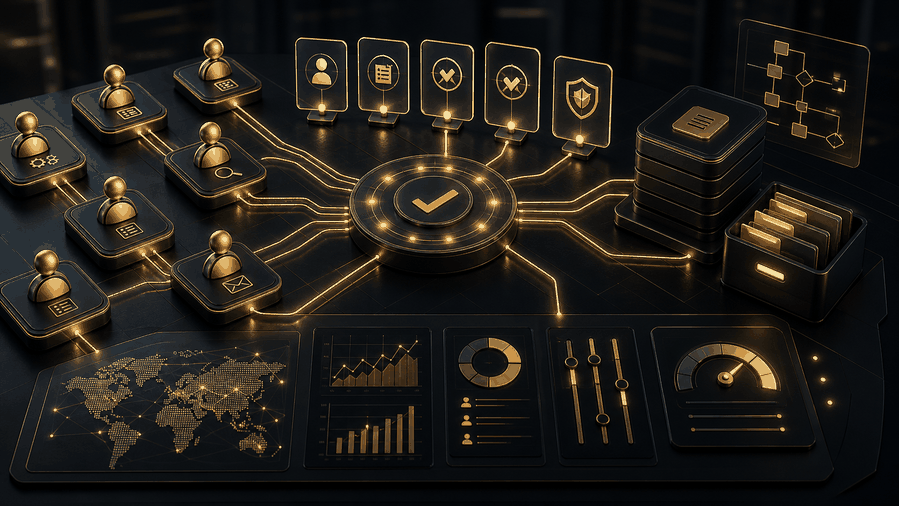
Data-driven workflow systems are replacing manual coordination in DACH enterprises.
The Five Automation Layers Every DACH Enterprise Needs
1. Document & Data Extraction
The majority of operational inefficiency in DACH enterprises begins with documents: invoices, contracts, compliance forms, delivery notes, customer correspondence. Manual document processing is not just slow — it is error-prone in ways that compound across the organisation. AI-powered document extraction, built on modern vision-language models, can process structured and semi-structured documents with accuracy rates exceeding 97%, routing exceptions to human review automatically. For a typical Viennese B2B firm handling 200–400 documents per day, this single layer alone can reclaim 15–20 hours of staff time per week.
The implementation approach matters enormously here. The mistake most enterprises make is purchasing an off-the-shelf document AI tool and plugging it into existing systems without redesigning the data flows downstream. Document extraction is only valuable if the extracted data flows cleanly into the next system — ERP, CRM, compliance log, or approval workflow. Extraction must be designed as a layer in a connected system, not as a standalone capability. This requires mapping your current document flows in detail before selecting any tooling.
2. Workflow Orchestration
Once data is extracted, something must decide what happens next. Workflow orchestration is the connective tissue of an automated enterprise — the layer that routes tasks, triggers actions across systems, manages approvals, escalates exceptions, and ensures that nothing falls through the gaps between tools. Modern orchestration platforms (n8n, Temporal, custom-built solutions) allow DACH enterprises to model complex multi-step business processes as explicit, auditable workflows that execute reliably without human intervention. For compliance-heavy industries — financial services, healthcare, manufacturing — this auditability is not just useful, it is legally required.
Effective orchestration requires treating workflows as software: version-controlled, tested, monitored. Too many enterprises implement workflow automation as a series of informal integrations — Zapier connections and Excel macros that work until they don't. Production-grade orchestration means your workflows have health checks, alerting, and rollback capabilities. When a downstream API changes or an upstream data format shifts, your orchestration layer catches the error and notifies the right person rather than silently failing for three days before someone notices.
3. Decision Automation
Not every decision in a business needs a human. Many decisions are rule-based, repetitive, and low-stakes — credit limit approvals within defined bands, shipment routing based on cost and time parameters, customer tier classification based on transaction history. Decision automation applies structured rule engines and lightweight ML models to these decisions, executing them in milliseconds with full logging. The result is not just speed — it is consistency. Automated decisions do not have bad days, do not apply rules differently on a Friday afternoon, and do not require escalation queues that back up when key staff are on holiday.
The critical design principle for decision automation in DACH enterprises is explainability. Under the EU AI Act, automated decisions that affect individuals or businesses must be explainable and contestable. This means your decision automation layer must log not just the output but the inputs and the rules applied. This is not technically difficult to implement — but it must be designed in from the start. Retrofitting explainability onto a black-box decision system is expensive and often impossible without rebuilding from scratch.
4. Customer Communication
AI-powered customer communication is the most visible layer of automation — and the one most prone to misimplementation. The goal is not to replace human customer relationships with chatbots. The goal is to handle the high-volume, low-complexity communication that currently consumes disproportionate staff time: order status updates, invoice queries, appointment confirmations, FAQ responses, onboarding sequences. Handled well, automated communication feels responsive and professional. Handled poorly, it damages the brand trust that DACH B2B enterprises spend years building.
The key to effective customer communication automation is knowing precisely where to draw the human handoff line. Every automated communication system must have clear triggers for escalating to a human: sentiment thresholds, topic categories, customer tier, transaction value. The automation handles the volume; the human handles the relationship moments that matter. This hybrid model is not a compromise — it is the correct design. Enterprises that implement it well report higher customer satisfaction scores than before automation, because response times improve dramatically while relationship quality is maintained for the interactions that count.
5. Reporting & Compliance Logging
The final automation layer is the one that makes all the others defensible: systematic reporting and compliance logging. Every automated action in your system must be logged, timestamped, attributable, and retrievable. This is partly a regulatory requirement under EU AI Act and GDPR. But it is also a business intelligence asset. Automated compliance logs, properly structured, become the dataset that allows you to continuously improve your automation systems, identify failure modes before they become incidents, and demonstrate operational excellence to enterprise customers and auditors.
Reporting automation means that your operational dashboards update in real time without anyone preparing reports, your compliance submissions are generated from system logs rather than manual compilation, and your leadership team has accurate operational data available at any time rather than waiting for end-of-month aggregations. For DACH enterprises operating in regulated markets, the ability to produce a complete audit trail for any automated decision or action — on demand, within minutes — is becoming a baseline expectation rather than a differentiator.
Common Mistakes Austrian Founders Make When Automating
The enthusiasm for AI automation in 2026 has produced a generation of failed projects alongside the successes. The failures share recognisable patterns, and understanding them before you begin is the fastest way to avoid joining that cohort. The first and most common mistake is automating broken processes. If your invoice approval workflow takes 12 steps and involves three departments with unclear handoffs, automating that workflow produces a fast, expensive, broken process. Automation amplifies whatever is already there — including the dysfunction. The correct sequence is always: map the process, redesign it for efficiency, then automate the redesigned version. Skipping the redesign step is the single greatest predictor of automation project failure.
The second pattern is skipping change management. Automation does not happen to systems — it happens to people. When a finance team member's job changes because invoice processing is now automated, that person needs to understand why, what their new role looks like, and how to operate in the new system. Enterprises that treat automation as a purely technical project and neglect the human adoption dimension consistently underperform in measured outcomes, even when the technical implementation is sound. Third, choosing tools before mapping workflows is endemic in the startup and SME world. A founder reads about a promising AI tool, buys a subscription, and tries to fit their processes around the tool's capabilities — backwards from how it should work. The workflow design must precede tool selection, always. Finally, underestimating integration complexity is responsible for a significant portion of blown timelines and budgets. Modern enterprise environments have 20–50 software systems, many of them legacy platforms with limited or undocumented APIs. Integration is not a minor step — in complex environments, it accounts for 40–60% of total implementation effort.
Illustrative Scenario — From Manual to Automated: A Vienna SME Story
Illustrative scenario — not a verified client result; demonstration specimen, not an implementation promise.
Consider this demonstration specimen: a Vienna-based B2B logistics coordination firm with 45 employees and €12M in annual revenue. Assume its operations team of 8 people spends 60% of its time on "glorified copy-paste": extracting shipment data from supplier PDFs, entering it into the TMS, cross-referencing customer orders in the CRM, and manually generating status emails. The figures define the scenario inputs; they are not client evidence. The processes may be reliable, but the capacity ceiling would force a choice between more headcount and a fundamental redesign of how work moves through the organisation.
Over 90 days, the scenario would first map every document flow and redesign the data model, then test a three-layer system: AI document extraction for supplier PDFs, with accuracy validated before any production cutover; an orchestration layer connecting approved outputs to TMS and CRM through controlled APIs; and a communication layer drafting status updates from shipment events. The legacy TMS adapter would remain a delivery dependency, not an assumed implementation success.

Before any of this can be called a result, manual processing time, data-entry errors and customer responsiveness would need to be tracked against an agreed baseline over a full production quarter, not read from a pilot window. The intended operating decision would be whether capacity can move from transcription toward relationship management and exception handling without weakening control.
Implementation cost — the consulting engagement, custom integration development, and first-year platform licensing — and the operational savings from reduced manual labour and error correction would need to be tracked against the firm's actual invoices and time logs, not projected from the design phase, before any payback period could be stated. That measurement discipline, not a headline number, is what determines whether automation of this kind is worth replicating for other DACH SMEs of similar scale and complexity.
AI Automation ROI: What DACH Leaders Are Actually Seeing
The ROI question is the one every executive asks before approving an automation initiative. The data from implemented projects in the DACH region over the past 18 months is now substantial enough to provide reliable benchmarks. These are not marketing projections — they are measured outcomes from production deployments across manufacturing, logistics, financial services, and professional services firms in Austria, Germany, and Switzerland.
These figures hold across company sizes from 20-person SMEs to 500-person mid-market firms, with implementation costs scaling accordingly. The key variable that determines ROI velocity is not company size — it is process clarity. Firms that arrive at automation with well-documented, consistently-followed processes see ROI within 6–9 months. Firms that must invest in process design first see ROI at 12–18 months but often report that the process design work alone delivered significant value independent of the automation. The lesson: process clarity is valuable whether or not you automate. Automation simply monetises that clarity faster.
The EU AI Act — What DACH Automation Leaders Must Know in 2026
The EU AI Act is now the primary regulatory framework shaping how DACH enterprises can deploy AI automation systems. For most business process automation use cases — document processing, workflow orchestration, reporting — the risk classification falls into the "limited risk" or "minimal risk" categories, which carry transparency and logging obligations but do not require the extensive conformity assessments required for high-risk AI systems. However, automation systems that make or influence decisions about employees, credit assessments, insurance underwriting, or access to essential services may fall into the high-risk category, requiring full documentation, human oversight mechanisms, and registration in the EU AI Act database.
The practical implication for DACH automation leaders is that compliance cannot be retrofitted. Every automation system deployed in 2026 and beyond must be designed with EU AI Act requirements in mind from day one: logging of inputs and outputs, human override capabilities, clear documentation of training data and model limitations, and a designated responsible person for each automated decision system. The compliance cost of doing this upfront is marginal. The cost of rebuilding non-compliant systems after a supervisory authority investigation is not. AIOpera's compliance-first architecture provides a reference implementation for enterprises that want to build AI automation systems that are defensible under EU AI Act scrutiny from the start.
One critical nuance that many DACH enterprises are not yet aware of: the EU AI Act applies to AI systems used within the EU, not just to systems built in the EU. If your enterprise uses an AI automation platform built by a US vendor, your enterprise — as the deployer — bears the compliance obligations under the Act. This means that vendor selection for automation tooling must include a thorough assessment of how that vendor supports your EU AI Act compliance obligations, including data residency, audit log access, and incident reporting capabilities.
A 90-Day Automation Roadmap for DACH Enterprises
The single most common question from Austrian and German executives who have decided to move on automation is: where do we start? The answer is always the same: with rigorous process mapping, not with technology selection. Here is the 90-day framework we use with every DACH enterprise client.
- Month 1: Audit & Map. Conduct a comprehensive process audit across all departments. Identify every process that involves data transfer, document handling, repetitive decision-making, or status communication. Score each process on two dimensions: automation potential (how rule-based and consistent is the process?) and business impact (what is the cost — in time, errors, and opportunity — of the current manual approach?). Prioritise the top 3–5 processes that score highest on both dimensions. Map these priority processes in detail: every step, every input, every output, every exception. Identify all systems involved. Document integration points and assess API availability. By the end of Month 1, you should have a clear picture of what you are going to automate and a realistic understanding of the integration complexity involved.
- Month 2: Design & Pilot. Redesign your priority processes for automation-readiness. This often means simplifying approval chains, standardising input formats, and eliminating unnecessary steps before writing a line of automation code. Once the redesigned process is approved by process owners, build a pilot automation for the single highest-priority process. Deploy it in a controlled environment with a subset of real transactions. Measure accuracy, exception rates, and processing time against your baseline. Use the pilot data to validate your ROI projections and identify integration issues before full deployment. Change management work begins in Month 2: brief affected teams, run training sessions, and establish the escalation and override procedures that will govern human-in-the-loop moments.
- Month 3: Deploy & Measure. Deploy the pilot automation to full production and begin deploying the next priority processes in parallel. Establish operational monitoring: dashboards showing processing volumes, error rates, exception queues, and system health. Define your KPIs — the specific metrics that will demonstrate ROI — and begin tracking them from Day 1 of production deployment. Schedule a 30-day post-deployment review to assess performance against projections and identify optimisation opportunities. By the end of Month 3, you should have at least one fully automated process delivering measurable results and a clear deployment plan for the remaining priority processes.
Expanding Your Automated Operations to Dubai and the Gulf
One of the most significant strategic advantages of building strong automation foundations in DACH is the leverage it creates for international expansion. DACH enterprises that have automated their core operations — particularly document processing, compliance logging, and customer communication — can expand into new markets without proportionally scaling their headcount. This is the operational model that makes Dubai and Gulf market entry viable for mid-market DACH companies that would otherwise lack the operational capacity to support international offices.
Dubai's position as the gateway to the Gulf Cooperation Council market, combined with Vision 2030's explicit mandate for AI and digital transformation across UAE government and enterprise sectors, creates a highly receptive environment for DACH companies that arrive with proven AI automation capabilities. The Dubai market values operational sophistication — companies that can demonstrate automated compliance reporting, real-time operational visibility, and scalable customer communication systems are positioned as credible enterprise partners rather than foreign vendors testing the market. The Dubai market entry strategy for AI-ready DACH enterprises is fundamentally different from traditional market entry: the automation foundation you build at home becomes the operational infrastructure that makes Gulf expansion feasible.

Dubai's Vision 2030 creates exceptional opportunities for AI-ready European enterprises.
The practical path for DACH enterprises looking at Dubai expansion is to ensure that automation systems are built with multi-jurisdiction operation in mind from the start. This means document processing systems that handle Arabic-language inputs alongside German, compliance logging frameworks that can accommodate both EU AI Act and UAE AI regulatory requirements, and communication systems that can operate across time zones without requiring round-the-clock staffing. Digital Systems & AI Integration services designed for international scalability are fundamentally different from domestic-only implementations — the architecture decisions made early have long-term implications for how easily the system extends to new markets.
Choosing the Right Automation Partner in Vienna
The Vienna market for AI automation consulting has expanded rapidly in 2025–2026, with a proliferation of vendors ranging from established technology integrators to newly formed boutiques staffed by junior developers with limited operational experience. Choosing the wrong partner is expensive — not because the initial engagement fails immediately, but because poorly designed automation systems create technical debt that compounds over time. What should you look for? First, demonstrated process design capability before technology capability. An automation partner who leads with tool recommendations before understanding your processes is a red flag. Second, EU AI Act fluency — your partner must understand the regulatory requirements and build compliance into their delivery methodology, not treat it as an afterthought. Third, references from DACH enterprises of similar size and complexity, with measurable outcomes, not just completed projects.
What to avoid: partners who propose automation without a process redesign phase, vendors who cannot explain their integration methodology for legacy systems, and consultants who recommend tools they happen to resell over tools that fit your actual requirements. My approach to automation engagements begins with a structured assessment of your current operational state — a no-assumptions, process-first audit that produces a clear picture of where automation will deliver the highest return, what it will cost to implement properly, and what it will require from your team to operate successfully. The goal is not to sell you the most automation possible — it is to design the right amount of automation, implemented correctly, that produces defensible and measurable results within a defined timeframe.
FAQ: AI Automation for DACH Companies
What is AI workflow automation for DACH companies?
AI workflow automation connects document extraction, ERP/CRM updates, workflow routing, customer communication, and audit logging so Austrian, German, and Swiss teams can remove repetitive manual work without losing control.
Which workflows should be automated first?
Start with high-volume, rules-based bottlenecks that touch ERP or CRM data, such as invoice handling, order status updates, supplier document processing, reporting, and exception routing.
How do you stay EU AI Act compliant?
Classify each automation by risk, keep human oversight for sensitive decisions, log inputs and outputs, document model limits, and choose vendors that support data residency, audit access, and incident reporting.
How long does the first production automation take?
Timing depends on the scope of the process, how ready your evidence and documentation are, and how quickly your team can grant system access for integration work. A narrow, well-documented process moves through audit, pilot, and production deployment far faster than one requiring extensive discovery or legacy system integration.
"The enterprises winning in 2026 are not the ones with the most AI tools — they are the ones that designed their operations to be AI-ready from the foundation."
Ready to audit your workflows? Start with Digital Systems & AI Integration — a structured assessment of your current automation gaps and highest-ROI opportunities.
Related reading: Explore Legacy Modernization for system hardening, Startup Development for venture-scale operations, and AI Operations Playbook for production-grade AI governance.
Continue Reading