Entry point
One consequential workflow, not a broad transformation programme.

Systems architecture · service
Start with the bottleneck, the decision and the accountable operator. Technology comes after the operating truth is visible.
Scope is set only after the real workflow has been reviewed.
Decision signals
One consequential workflow, not a broad transformation programme.
Ownership, review gates and data boundaries made explicit.
Every phase ends with a defensible continue, change or stop decision.
The operating problem
Tools do not resolve unclear handoffs, missing ownership or decisions that cannot be reconstructed.
The first move is to reconstruct the actual operating flow: who decides, what evidence they use and where exceptions or repeated work accumulate.
Only then can the team decide what to standardise, assist, automate or deliberately keep under human judgement.
System method
The architecture connects business logic, technical boundaries and accountable ownership.
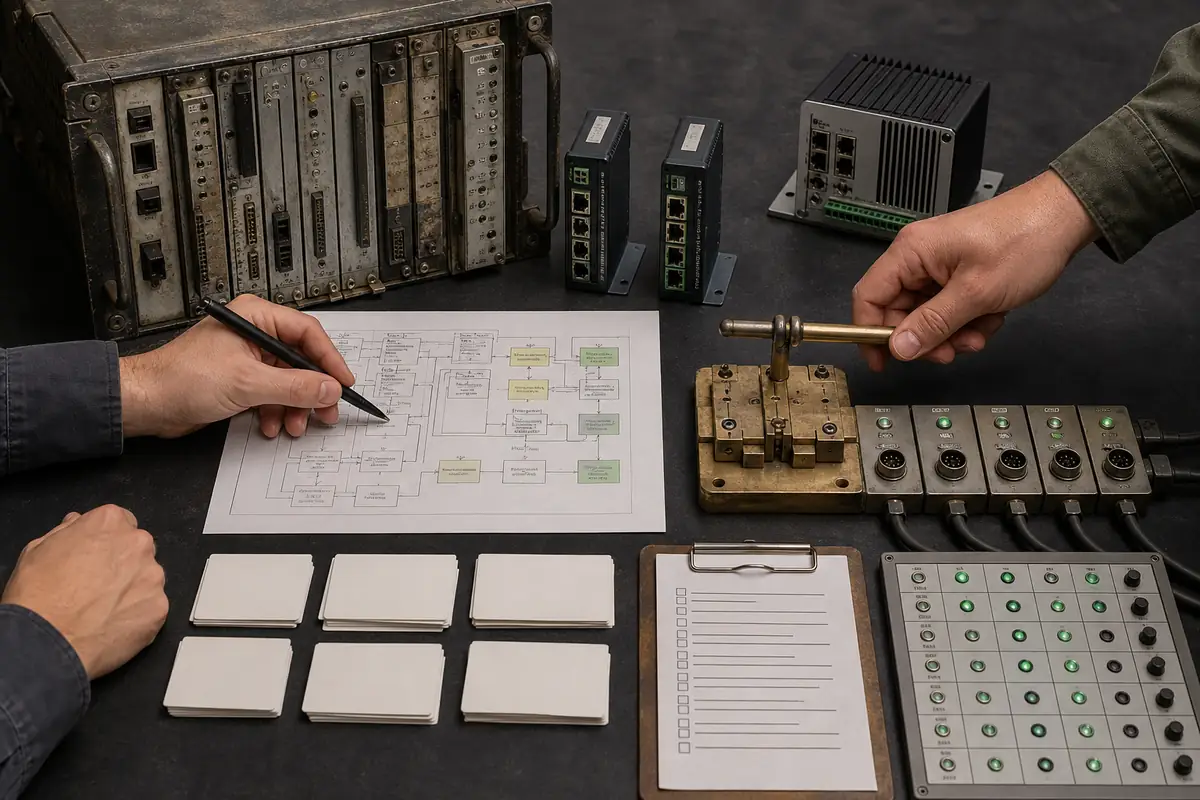
Map decisions, handoffs, exceptions and control gaps as one system.
Set data access, human review, escalation and evidence requirements deliberately.
Test the critical assumptions in real work before expanding scope.
What the work produces
The work produces artefacts an operating team can inspect, challenge and use.
Workflow, roles, data and dependencies in one operating view.
Review gates, escalation paths and evidence for consequential decisions.
Priorities and dependencies for a controlled introduction.
A clear recommendation with conditions, risks and open assumptions.
Illustrative operating scenario
Illustration, not a customer caseIllustrative scenario — not a customer case
A leadership team sees persistent delay even though each tool appears modern. Mapping the system reveals that approval, data access and exception handling are split across roles. The useful first move is not another purchase; it is a controlled flow with named owners.
Purpose: explain the method. No operating outcome is claimed. This scenario explains the method. Impact must be measured in the specific operating environment.
Execution roadmap
Clarify the current flow, risk and desired business change.
Set roles, controls, data paths and exception handling.
Observe the system in real work and expand only when evidence supports it.
Questions worth resolving
A specific workflow or decision whose friction and business consequence can be described clearly.
No. The system need is established first; implementation follows only when boundaries and ownership are clear.
Through small inspectable steps, human review, documented assumptions and explicit stop conditions.
Primary references
References inform the operating context; they do not imply endorsement.
Request a Legacy Workflow Assessment
The first conversation should establish whether this is a system problem, what evidence is missing and what next step is responsible.