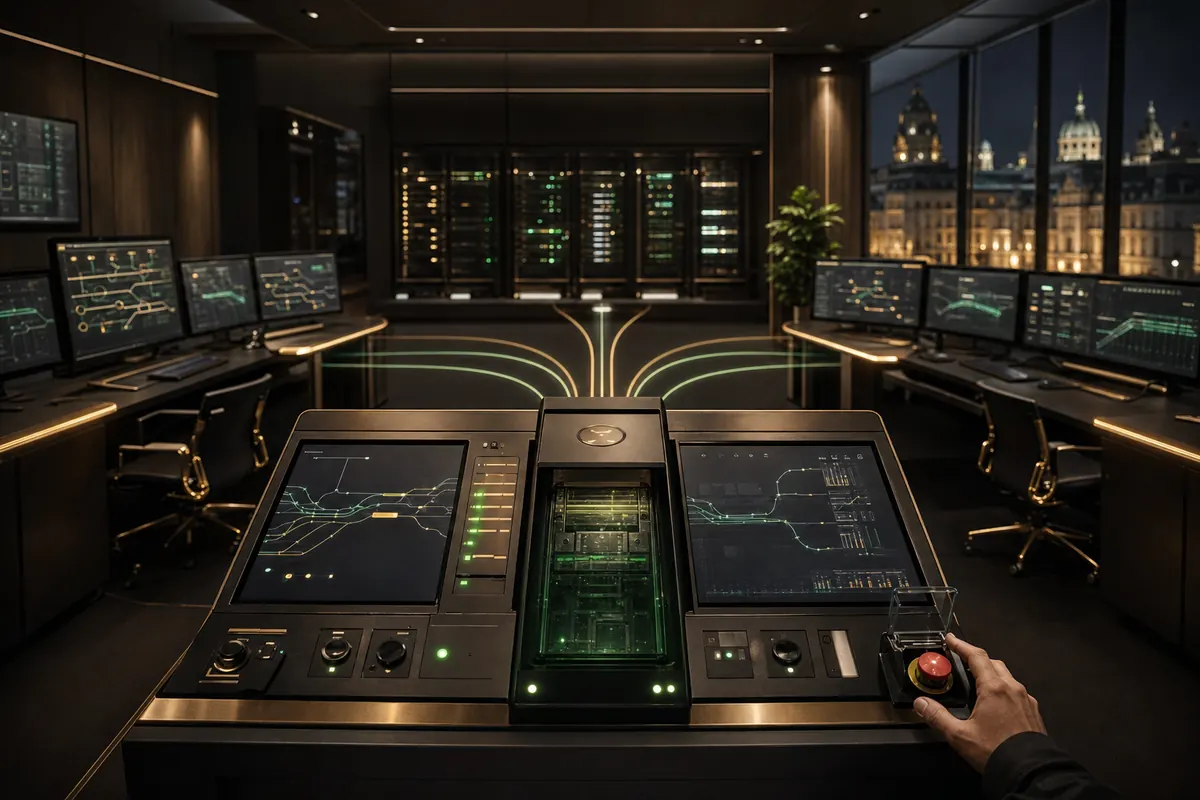
12 July 2026. At 06:55, before the European shift begins, an international operations leader opens three dashboards. One customer-service agent is calling a case system through a managed connector. A procurement agent reaches supplier data through a developer-hosted MCP server. A third agent, built by a regional team, sends requests to a different endpoint with its own credential and retry logic. All three are useful. None appears on the same operating view.
By 09:20, a supplier endpoint is returning partial failures. The procurement agent retries, the service agent slows down, and finance asks which region is driving the week's model and tool spend. The operations leader can see task outputs, but there is no shared view of cost, no shared view of failures, and no reliable emergency control across the agent fleet. The problem is no longer whether the agents work. It is whether the company can operate the traffic they create.
This is a realistic composite scenario assembled from common international operating patterns. It is not a client case, and it makes no claim about a client result. By the end of this guide, you will be able to distinguish an MCP server, an agent gateway, and a control plane; build an Agent Traffic Map; define runtime policies and business metrics; design an emergency-stop procedure; and turn those controls into a practical 30/60/90-day rollout.
The operational shock: connection has outrun control
The shocking fact is not that an agent can call twenty tools. It is that a company can reach twenty tools without being able to answer five elementary questions in one place: which agent called, under whose authority, for what purpose, at what cost, and how the call can be stopped now.
MCP and agent-to-agent protocols reduce integration friction. They help software discover capabilities, exchange context, and invoke tools in a more consistent way. That is valuable infrastructure. But connectivity is not the same as an operating model. A protocol does not automatically know your approval limits, customer promises, data classifications, cost ownership, incident roles, or acceptable failure modes.
A useful agent pilot can therefore become an invisible production network. Teams add endpoints because each local decision is reasonable. The aggregate result is fragmented identity, duplicated controls, inconsistent logging, uncertain spend, and no tested way to pause the whole path from request to external action.
Operating principle: govern the traffic, not the demo
The core idea is simple: every consequential agent action should pass through a visible, policy-enforced, attributable operating path. That path may use several technical components, but the leadership decision comes first. The organisation must decide which traffic matters, where policy is enforced, what evidence is retained, and who has authority to intervene.
An agent gateway and control plane are complementary, not interchangeable. The gateway sits in the live path and makes a decision about traffic now. The control plane manages the wider fleet, policies, ownership, health, and change over time. An MCP server exposes tools and context. Calling all three “the MCP layer” hides responsibilities that operators need to keep separate.
This guide is vendor-neutral. It is an operating design, not a setup tutorial or a recommendation to resell a platform. Product capabilities can support the design, but no product removes the need for accountable owners, business boundaries, tested policies, and incident practice.
Target state: one operating picture, bounded autonomy
Success is not a wall of technical telemetry. The target state is an operating picture where a leader can see active agents, tool destinations, policy decisions, exceptions, latency, cost, and business outcomes without reconstructing the story from five teams. Ordinary, reversible work moves quickly. High-impact or unusual work stops at an explicit approval gate. A tested emergency stop path can contain risk without destroying evidence or leaving downstream jobs running.
The achievement is practical: faster cycle time with stable quality; broader automation with fewer unknown credentials; clearer cost attribution without slowing every request; and incidents that can be contained, explained, and recovered. These are operating outcomes, not claims that autonomy is risk-free.
Start with an Agent Traffic Map
An Agent Traffic Map is the first management artifact. It shows how work moves from a human or system trigger, through an agent and its runtime, to an MCP server or other tool endpoint, then into a business action. Build it from observed calls and owner interviews, not architecture slides alone. Shadow automations and vendor-embedded agents rarely appear on the official diagram.
Map one real journey end to end
Choose a workflow with enough value to matter and enough reversibility to examine safely. For each hop, record the requesting team, agent identity and version, runtime, endpoint, tool operation, target system, credential source, data class, business owner, technical custodian, geographic route, expected volume, retry behaviour, approval point, log location, and stop mechanism.
Then mark where the map is uncertain. “Owned by IT” is not an owner. “Uses SSO” does not explain which workload identity acts. “Logged in the platform” does not prove that the destination result, policy decision, cost, and human intervention can be correlated into one case.
Ask four questions at every connection
- Purpose: what business outcome justifies this call, and what would count as misuse?
- Authority: which identity acts, what operations can it perform, and when does access expire?
- Evidence: can an operator reconstruct the request, decision, destination response, and final effect?
- Containment: can new traffic stop, active authority be removed, and incomplete work move to a safe fallback?
The map should connect to the broader digital systems and AI architecture. If an older application cannot expose action-level permissions or reliable events, record that in the legacy modernization backlog. The service is systems architecture and operational control, not an integration sales pitch.
MCP server, agent gateway, and control plane are different jobs
The table below provides a clean gateway versus control plane distinction while preserving the MCP server's separate role.
| Layer | Primary job | Typical decisions | What it does not solve alone |
|---|---|---|---|
| MCP server | Exposes named tools, resources, and context through a standard interface. | What capabilities exist, their schemas, and how a client can call them. | Enterprise-wide ownership, spend control, incident command, and complete organisational policy. |
| Agent gateway | Intermediates live agent traffic before it reaches models, tools, or other agents. | Authenticate, allow, deny, narrow, route, rate-limit, log, or require approval for a request. | Fleet lifecycle, portfolio priorities, owner accountability, and long-term operating improvement. |
| Control plane | Provides the management view across agents, gateways, policies, credentials, health, and change. | Which policy version is active, who owns an agent, where risk is concentrated, and whether deployment should expand. | The actual in-path enforcement unless it is connected to a gateway or another policy-enforcement point. |
A small company may implement these jobs with fewer products or services. A large company may use several gateways under one control plane. The labels matter less than the separation of duties: capability exposure, runtime enforcement, and fleet management must each have an explicit home.
Runtime policies turn boundaries into decisions
A policy PDF cannot govern a tool call. Runtime policies translate business boundaries into allow, deny, narrow, route, or approval decisions while the action is still preventable. They belong outside the model's negotiable instructions and should be versioned, tested, observed, and owned.
Write policy around consequence and context
A useful runtime policy combines identity, purpose, operation, data, destination, value, location, time, and current risk. For example: a verified service agent may read the status of the requesting customer's open case during an active support session. It may draft a response. It may not export a customer list, alter a contract, or send a refund above the approved threshold without a named human approval.
- Identity policy: accept only known agent versions and short-lived workload credentials.
- Tool policy: separate read, draft, submit, approve, and execute operations.
- Data policy: limit categories, records, fields, geography, retention, and outbound destinations.
- Economic policy: assign budgets, rate limits, model routes, and exception thresholds by workflow.
- Change policy: use staged rollout, policy versioning, expiry dates, and rollback criteria.
Default denial is appropriate when identity, purpose, or destination cannot be established. For a low-impact transient failure, a constrained retry may be better. Policy quality is not measured by the number of blocks. It is measured by whether permitted work stays fast while material exceptions reach the right accountable person with enough evidence to decide.
Ali's operational analysis of the 2026 signals
Vendor claim, Citrix, July 9, 2026: the Citrix NetScaler MCP Gateway announcement describes central routing, authentication, allow and block controls, rate limits, monitoring, model routing, and usage visibility. These are Citrix's stated product capabilities, not independently verified outcomes for your organisation.
Vendor claim, IBM, July 2, 2026: IBM's Agentic Control Plane announcement presents fleet discovery, runtime policy, credential and access visibility, guardrails, cataloguing, and operational alerts. This is IBM's product framing; it does not by itself establish that a specific deployment has complete governance.
Public standards signal, NIST, February 17, 2026: the NIST AI Agent Standards Initiative focuses on secure, reliable, interoperable agent adoption and includes work on identity and security. It signals the direction of standards work, not a certification of any gateway architecture.
Research finding, June 30, 2026: the paper Governance Gaps in Agent Interoperability Protocols: What MCP, A2A, and ACP Cannot Express analyses protocols for coordinating agent communication and access while identifying unresolved governance and security challenges. It supports a critical distinction: interoperable messages do not encode an organisation's full responsibility model.
Vendor perspective, Microsoft, June 2, 2026: Microsoft's article on the system around AI argues for an integrated lifecycle spanning context, runtime governance, observability, and improvement. That is Microsoft's perspective, not evidence that one product or architecture fits every operating environment.
Ali's operational analysis: these sources converge on a practical pattern even though their purposes differ. Tool interoperability is expanding, traffic enforcement is becoming a distinct layer, and fleet-level management is becoming necessary. The management conclusion is not “buy a gateway and governance is done.” It is “make agent traffic visible, place enforceable decisions in its path, and connect those decisions to owners, outcomes, and incident authority.”
Operating recipe: use the GATE model
GATE is a compact operating recipe for taking one mapped agent journey from connection to controlled production. Each step has a different owner conversation and a different test.
G - Govern
Name one accountable owner, state the business purpose, list the approved systems, assign every input and output a data class, and define the business boundary the agent may not cross. The test is whether a non-technical process leader can decide if a proposed call belongs to the approved job.
A - Authorize
Make every decision identity-aware. Grant least privilege through time-bounded credentials, limit tool access to the necessary operation and records, and place an approval gate before high-impact, irreversible, unusual, or externally binding actions. The test is whether expired, ambiguous, or excessive authority is rejected before execution.
T - Trace
Correlate the original request, selected tool, policy decision, destination outcome, end-to-end latency, model and tool cost, every exception, and any human intervention. The test is whether an operator can reconstruct one case quickly without asking several engineering teams to merge logs.
E - Emergency-stop
Run a tested pause that blocks new work, revoke active credentials and grants, move incomplete cases to a safe fallback, define controlled recovery, and hold a post-incident review before restoring autonomy. The test is effective containment, not whether someone clicked a button.
A practical scorecard for production readiness
Score each line 0 for absent, 1 for partial or untested, and 2 for implemented with current evidence. The total is useful for prioritisation, but a high score cannot compensate for a missing owner, unenforced high-impact boundary, incomplete trace, or untested stop path.
| Control area | Evidence to inspect | Operating metric |
|---|---|---|
| Inventory and ownership | Current map, named business owner, technical custodian, review date. | Percentage of observed traffic assigned to an approved agent and owner. |
| Authority | Identity, permission set, credential lifetime, approval evidence. | Denied calls, expired grants, approval wait time, and bypass attempts. |
| Trace quality | One correlated case from trigger through destination effect. | Evidence completeness and time to reconstruct an exception. |
| Reliability and value | Baseline, outcome sample, correction log, workflow cost. | Completion, correction, p95 latency, cost per completed case, cycle time. |
| Containment | Exercise record, revoked grant evidence, queued-work disposition. | Time to stop effective access and time to restore controlled service. |
Choose business metrics before expansion. Technical call success can rise while customer resolution worsens. Cost per token can fall while duplicate actions increase. Track technical health, policy health, task quality, and business effect together. For finance-grade value claims, connect the same baseline and evidence to a CFOProof operational value review.
30/60/90 roadmap: from visibility to operating proof
First 30 days: map and bound
- Observe one valuable workflow and document its triggers, identities, endpoints, tools, data, credentials, owners, volume, cost, and downstream effects.
- Record baseline cycle time, completion, correction, exceptions, approval delay, and cost per completed case.
- Choose the in-path enforcement point and write the first five consequential policies in business language.
- Assign incident authority and define what incomplete work does when traffic is paused.
Days 31-60: enforce and observe
- Introduce unique workload identity, short-lived access, operation-level permissions, policy versioning, and correlation IDs.
- Connect request, policy, tool response, final effect, exception, human decision, latency, and cost into one operating view.
- Test normal, denied, delayed, duplicated, malformed, over-budget, unavailable-tool, and approval-timeout cases.
- Review exceptions weekly with business, operations, security, finance, and the technical custodian.
Days 61-90: prove and decide
- Run a live containment exercise during a realistic shift handover and verify downstream authority is actually removed.
- Compare results with the baseline by region and case type; separate verified gains from assumptions.
- Decide to expand, hold, narrow, return to assisted mode, or retire the workflow based on evidence.
- Reuse the control pattern for a second workflow only after ownership and operational capacity are proven.
Frequently Asked Questions
What is the difference between an MCP server and an AI agent gateway?
An MCP server exposes tools, resources, and context through the Model Context Protocol. An AI agent gateway intermediates live traffic and can authenticate, route, restrict, observe, or stop calls according to policy. The server makes a capability callable; the gateway controls how approved traffic reaches it. Neither one, by itself, supplies the organisation's full ownership and operating model.
Do we need both an agent gateway and a control plane?
You need both jobs, although they may be implemented in one platform or several components. The gateway enforces decisions in the request path. The control plane manages the wider fleet, policy versions, ownership, credentials, health, and change. For a small scope, the implementation can be lightweight; the responsibilities should still be explicit.
Which runtime policies should we implement first?
Start with policies that prevent the largest credible consequence: unknown identities, sensitive data leaving an approved boundary, write or execute actions beyond a defined scope, material commitments without approval, and uncontrolled retries or spend. Use one mapped workflow, test the policies against real exceptions, and expand only when false blocks and missed boundaries are understood.
How should an AI agent kill switch be tested?
Test the full emergency stop path, not only the user interface. Block new work, remove active credentials and delegated authority, contain queued and in-flight jobs, preserve evidence, route incomplete cases to a safe fallback, and require an authorised recovery decision. Measure the time until effective access is gone and include nights, weekends, and owner absence in the exercise.
Book an AI Systems Review
Bring one live or near-production agent workflow, its known endpoints, one week of logs, current credentials, approval rules, and the names of the people who operate it. In a practical AI Systems Review, we will build the first Agent Traffic Map, separate connection from enforcement and fleet control, identify the highest-consequence policy gaps, and define a measurable 30/60/90 operating plan.
Ali Najafzadeh works as an AI Systems Architect: connecting business responsibility, runtime policy, observability, cost evidence, and emergency control into an operating system leaders can use. Schedule an AI Systems Review to turn one agent journey into a controlled production pattern before multiplying traffic across the organisation.
Continue Reading