The most consequential shift in enterprise AI in 2026 is not happening at the model level. It is happening at the architecture level. Enterprises across the DACH region are beginning to encounter a new class of AI system — one that does not simply respond to a question or classify a document, but one that receives a goal, breaks it into sub-tasks, delegates those sub-tasks to specialist agents, uses external tools, monitors progress, and loops until the goal is completed. This is agentic AI. And it is qualitatively different from everything that came before it.
The companies that understand this distinction in 2026 will build durable operational advantages. Those that conflate agentic AI with chatbots — or assume that buying a ChatGPT subscription counts as AI transformation — will find themselves re-doing this work in 2027 at significantly higher cost and disruption. This article explains what agentic AI actually is, why now is the inflection point for DACH enterprises, what real implementations look like, and how to start without betting the business on an unproven architecture.
What Agentic AI Actually Means (Beyond Chatbots)
A chatbot takes an input and produces an output. It is reactive, single-turn, and stateless. You ask it a question; it answers. You close the window; nothing persists. This is useful — but it is a fraction of what AI systems can do, and it has almost no bearing on how complex business operations actually function.
An agentic AI system is different at every level. An agent receives a goal, not a prompt. It then autonomously decomposes that goal into a sequence of actions, selects and invokes the tools required to execute each action, evaluates intermediate results, adjusts its plan based on what it learns, and continues until the goal is achieved — or until it reaches a decision point that requires human judgment. This loop — plan, act, observe, adapt — is what makes an agent an agent rather than a model call wrapped in a function.
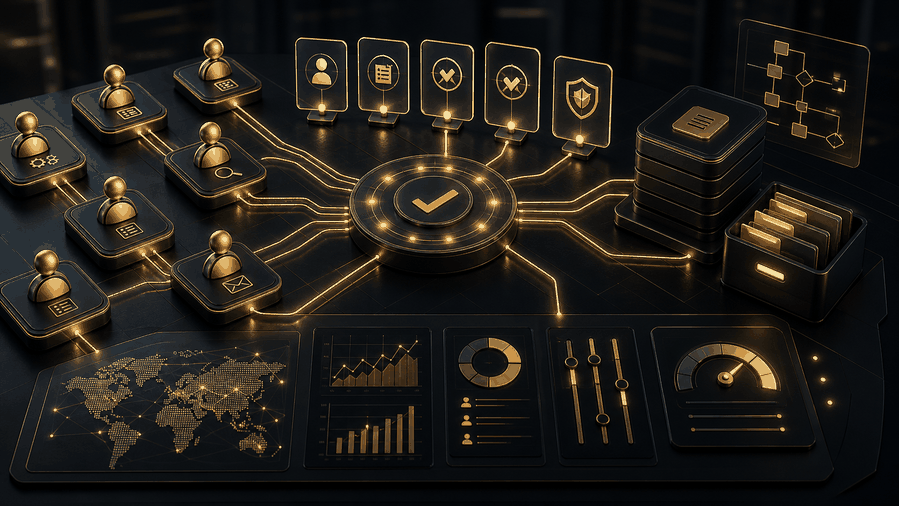
Multi-agent systems add a coordination layer on top of this. A controller agent (sometimes called an orchestrator agent) receives a high-level goal and dispatches sub-tasks to specialist agents, each of which has a specific capability set: one agent that reads and extracts from documents, another that queries your ERP system via API, a third that drafts communications and routes them for approval, a fourth that logs everything to your compliance system. None of these agents needs to know what the others are doing in full — they receive a task from the orchestrator, complete it, and return a result. The orchestrator synthesizes results and determines next steps.
This architecture enables something that was previously impossible with single-model AI: the execution of genuinely complex, multi-step business processes — the kind that today require a person to sit down, open five browser tabs, log into three systems, copy-paste data between them, wait for a response, and then repeat. Agentic AI systems do this end-to-end, autonomously, at the speed of an API call.

Multi-agent architectures coordinate specialist AI agents under a controller — enabling end-to-end business process automation.
What does this look like in practice? Consider a financial reconciliation process at a mid-sized Austrian manufacturing firm. Today: an accounts payable clerk downloads invoices from email, opens BMD, cross-references purchase orders, flags discrepancies, emails the relevant project manager, waits 24 hours, receives approval, posts the entry. Six touches. Four systems. Twenty minutes per invoice. Three hundred invoices a month.
With a multi-agent architecture: an ingestion agent monitors the email inbox and triggers on arrival. An extraction agent reads the PDF invoice using a vision-language model and structures the data. A validation agent cross-references purchase order data via BMD API. A discrepancy agent flags exceptions and routes them via structured message to the relevant approver in your existing communication system. An approval-loop agent waits for human sign-off on exceptions, then passes approved items to a posting agent that writes directly to BMD. A compliance agent logs the full decision chain for EU AI Act audit trail requirements. Total human time: reviewing flagged exceptions only — roughly fifteen invoices out of three hundred, each pre-packaged with full context. The other two hundred and eighty-five are processed without human involvement, faster, and with a complete audit trail.
That is what agentic AI means beyond chatbots. It is the difference between a tool that helps you think and a system that does the work.
Why 2026 Is the Inflection Point for DACH Enterprises
Three forces are converging in 2026 that make this the most important year for DACH enterprises to act on agentic AI — and the most dangerous year to wait.
The first is regulatory clarity. The EU AI Act is now fully operational. Its risk classification framework — which distinguishes between prohibited, high-risk, limited-risk, and minimal-risk AI applications — has moved from legislative ambiguity to enforcement reality. For DACH enterprises deploying AI in financial processing, HR decision support, customer credit scoring, or supply chain risk management, the Act mandates specific documentation, human oversight provisions, and system transparency requirements. Agentic AI systems, by their autonomous nature, carry heightened compliance obligations. The enterprises designing these systems today with compliance architecture built in will be in a defensible position. Those bolting compliance onto existing deployments after the fact will face both technical and legal remediation costs.
The second force is competitive pressure from AI-native challengers. Across every sector where DACH enterprises operate, new entrants from the US, the UK, and increasingly from within Europe are building operations on agentic AI from day one. They have no legacy infrastructure to protect, no change management inertia to overcome, and no incumbent vendor relationships preventing them from selecting the best tools. A Vienna logistics firm competing with an AI-native competitor that processes quotes in four minutes while the incumbent takes four hours is not facing a technology problem — it is facing an existential operational gap. The 18-month adoption lag that DACH enterprises have historically maintained relative to US counterparts is no longer survivable in every sector.
The third force is the maturity of the tooling. Until 2024, building production-grade multi-agent systems required bespoke engineering at considerable cost and risk. The frameworks, orchestration platforms, and model APIs available in 2026 have closed this gap dramatically. Agent frameworks are production-tested. Tool-calling APIs are reliable. The cost of multi-agent inference has dropped by over 80% in 18 months. What required a team of six ML engineers in 2023 can now be implemented by a competent systems architect with appropriate vendor tooling in weeks. The barrier is no longer technical capability — it is knowing which processes to target, how to design compliant architectures, and how to integrate with existing infrastructure without disruption.
"Agentic AI is not a tool. It is an operating system for your business workflows."
For Austrian and German Mittelstand companies, the implication is specific. The process discipline that defines DACH operations culture — documented workflows, clear ownership, systematic quality control — is precisely the foundation on which agentic AI systems perform best. Agents work reliably when processes are explicit and rules are clear. In markets where "how we do things" is written down and enforced, the translation to agent-executable logic is dramatically smoother than in organizations where institutional knowledge lives only in people's heads. DACH enterprises are not behind — they are uniquely positioned to implement agentic AI correctly, provided they move in 2026 rather than 2027.
Three Real Agentic AI Use Cases for Austrian SMEs
Abstract architecture is useful only when grounded in specific business processes. The following are three agentic AI decision scenarios for Austrian SMEs. Each requires workflow evidence, authority design, security and legal review, controlled evaluation and a separate production decision; none is a deployment promise or proof of current delivery capacity.
Use Case 1: Multi-Step Financial Document Processing with BMD and SAP
The most immediate ROI for most Austrian manufacturing, professional services, and distribution firms is in financial document processing. The process is universal: invoices, delivery notes, purchase orders, and approval documents flow through the business, touching ERP systems, spreadsheets, email inboxes, and human reviewers in complex sequences that are expensive in time and prone to error.
A multi-agent architecture for this process deploys four specialist agents in sequence. An ingestion agent monitors designated inboxes and document repositories, triggering on new document arrivals. An extraction agent applies a vision-language model to parse the document — extracting line items, amounts, dates, vendor identifiers, and PO references — and structures the output as a validated JSON payload. A routing agent cross-references the structured data against the ERP database (BMD or SAP, via API middleware), flags discrepancies above configured thresholds, and routes exceptions to the appropriate human reviewer with pre-packaged context. A posting agent, upon receiving human approval for exceptions and automated clearance for matched items, writes directly to the ERP system and logs the transaction with a full audit trail to a compliance datastore.
The result is a system where human attention is focused exclusively on genuine exceptions — the invoices that don't match, the amounts that exceed thresholds, the vendors that require additional review. Everything else executes without human involvement. For a firm processing 500 documents per month, this is an illustrative workflow scenario; recovered staff time and error rates on the automated portion depend on process quality, controls and exception rates, and require documented test evidence. The architecture integrates with existing digital systems and requires no ERP replacement — the agents communicate with BMD and SAP through API layers, leaving the core accounting infrastructure untouched.
Use Case 2: Automated Customer Service Triage and CRM Update Orchestration
The second high-impact use case is customer service operations — specifically, the triage and routing of inbound customer contacts across email, web forms, and messaging channels, combined with automated CRM record updating. This is a process that every DACH SME with a B2B customer base runs manually, and where the hidden cost is enormous: customer contacts go unacknowledged for hours, CRM records are updated inconsistently or not at all, and sales and service teams spend significant time on routing and documentation rather than customer interaction.
An agentic triage system deploys a classification agent that reads inbound contacts and categorizes them by intent (support request, sales inquiry, billing question, escalation, etc.) and priority (based on customer tier, issue severity indicators, and response SLA requirements). A context agent retrieves the customer's full history from the CRM — recent orders, open tickets, communication history, account value — and packages this as a briefing. A routing agent assigns the contact to the appropriate team member with the briefing pre-attached, reducing the time that team member needs to understand the situation before responding. A documentation agent, after the interaction is resolved, extracts key information and updates the CRM record automatically — contact log, issue resolution, follow-up actions, and next contact date.
The orchestrating controller agent monitors the queue, manages escalation rules, and surfaces situations where no action has been taken within SLA windows. Human team members interact with a structured interface — seeing pre-classified, pre-contextualized contacts rather than a raw inbox — and their responses trigger downstream automation rather than requiring manual CRM entry. For a Viennese B2B services firm handling 200 inbound contacts per week, this system typically reduces response latency by 65% and CRM documentation completeness by a factor of three.
Use Case 3: Supply Chain Monitoring with Human-in-the-Loop Approval
The third use case is supply chain risk monitoring — a process that has become mission-critical for Austrian manufacturing, food production, and distribution firms since the supply chain disruptions of 2021-2023. Most firms monitor supply chain risk reactively: a delivery fails to arrive, a supplier sends a delay notice, and someone scrambles. Proactive monitoring — watching for early signals of disruption across supplier networks, logistics providers, and market conditions — requires continuous data processing across multiple sources that no human team can sustain.
An agentic supply chain monitor deploys a data collection agent that queries configured data sources on a regular cycle: supplier portals, logistics tracking APIs, commodity price feeds, weather and geopolitical risk indicators, and your own ERP system for current stock levels and outstanding orders. An analysis agent synthesizes this data and scores supply chain positions by risk level — flagging suppliers, routes, and materials that exceed defined risk thresholds. A scenario agent models the downstream impact of flagged risks on production schedules, customer delivery commitments, and cash flow, producing a structured risk brief. A human-in-the-loop routing agent surfaces high-risk situations to the designated decision-maker — procurement director, COO, or plant manager — with full context and a set of proposed response options.
The critical design element here is the human-in-the-loop approval gate. For supply chain decisions with significant financial or operational consequences, the agent system surfaces the decision with its reasoning rather than acting autonomously. The human reviews the brief, selects or modifies the response, and the agent system executes the chosen action — communicating with suppliers, updating order quantities, triggering safety stock orders, or notifying downstream customers of potential delays. This design is consistent with EU AI Act requirements for human oversight in high-impact operational decisions and reflects the operational risk management culture of DACH enterprises. The system does not replace human judgment — it makes human judgment dramatically faster and better-informed.

Production agentic systems replace multi-step manual workflows with orchestrated agent pipelines — every step logged, every decision traceable.
The Architecture Behind Agentic Systems
Understanding the architectural pattern behind multi-agent systems is essential for evaluating vendors, assessing implementation proposals, and making informed decisions about which processes to automate first. You do not need to build this architecture yourself — but you should know enough to recognize a sound design from a fragile one.
The core pattern is a controller-specialist hierarchy. At the top sits an orchestrator agent — sometimes called a planner or controller — that receives the high-level goal and holds the plan. The orchestrator does not execute tasks directly; it delegates. Below the orchestrator are specialist agents, each with a defined capability set and access to a specific set of tools. An extraction agent has access to document parsing tools and vision-language models. A database agent has access to your ERP API. A communication agent has access to your email and messaging APIs. A compliance agent has access to your audit log storage. Each specialist agent executes its task, returns a result to the orchestrator, and waits for the next instruction.
This separation of concerns is what makes agentic systems maintainable and safe. When a specialist agent fails — because an API goes down, a document format changes, or a rate limit is hit — the orchestrator receives the failure, logs it, and decides how to proceed: retry, escalate to a human, or take an alternative path. Failures are isolated to the specialist level rather than cascading through the entire system. This is fundamentally different from simple automation pipelines, where a single point of failure breaks the entire process.
Production-grade agentic systems also require isolation at the execution level. Each agent run should execute in an isolated environment — separate process space, scoped permissions, no shared state with other agent runs — so that a misbehaving agent cannot corrupt the state of the system or access data outside its authorized scope. This isolation is a security requirement as well as a reliability one: it limits the blast radius of errors and prevents agents from being exploited to access data they should not see. In our implementations, we apply the same worktree isolation principle used in software development — each agent task runs in its own sandboxed context, with controlled access to external resources.
Observability is the final architectural requirement. Every agent action should be logged: what task was received, what tools were called with what parameters, what results were returned, what decision was made at each step. This logging serves three purposes: debugging when something goes wrong, auditing for EU AI Act compliance, and continuous improvement — analyzing agent decision patterns over time to identify where the system can be refined. Without observability, you have a black box that might be working. With observability, you have a system you understand and can improve.
For DACH enterprises considering their first agentic implementation, the right starting point is a process that is already well-documented, has clear rules for the majority of cases, and has a defined human escalation path for exceptions. Agentic AI amplifies process clarity — it does not create it. The best candidates are processes where a skilled employee could write down all the steps, the decision rules, and the exception conditions on two pages of paper. If you cannot write it down, the agent cannot execute it reliably.
What to Look for in an Agentic AI Implementation Partner
The market for AI implementation services in DACH is crowded, and the terminology has become sufficiently diffuse that distinguishing genuine capability from repackaged consulting is a real skill. Here are the criteria that separate implementation partners who can deliver production agentic systems from those who will charge you for a ChatGPT integration and call it transformation.
Systems architecture expertise, not just model expertise. Agentic AI is an engineering discipline, not a prompt engineering exercise. The partner you need understands API design, data pipeline construction, error handling at the systems level, and how to integrate new components with existing infrastructure — BMD, SAP, your CRM, your document management system — without disrupting operations. Ask them to describe the middleware architecture they would use to connect your ERP to an agent pipeline. If they cannot answer this in specific technical terms, they are not who you need.
Controls and evidence from the start. A credible agent architecture should address auditability, appropriate human oversight and documented risk-classification assumptions before production. Whether those controls satisfy legal obligations must be assessed by qualified legal and domain specialists; architecture is not a compliance certification.
Integration capability with DACH enterprise infrastructure. The Austrian and German enterprise technology stack has specific characteristics: BMD and SAP dominance in ERP, DATEV in accounting, established document management systems, and a preference for on-premise or private-cloud deployment over pure SaaS. A partner who has never integrated with these systems is starting from scratch on your project. Ask for specific examples of ERP integrations they have built and the architectural patterns they used. The ability to modernize and connect legacy systems without replacing them is a core competency, not a nice-to-have.
Not just ChatGPT wrappers. The most common failure mode in the current market is implementation partners who repackage off-the-shelf AI tools — typically OpenAI's API or Microsoft Copilot extensions — as bespoke AI systems and charge enterprise rates for the integration. These solutions are not inherently bad, but they are not agentic systems. They are API calls with some prompt engineering. Ask your potential partner to describe the agent orchestration framework they use, how they handle agent failures and retries, and what their approach is to state management across multi-step agent workflows. If they cannot answer these questions, you are looking at a wrapper, not an agentic system.
Execution track record, not slide decks. The single most reliable signal of a capable implementation partner is a portfolio of running systems. Not architecture proposals, not pilot results, not client testimonials — but systems that are executing in production today. Ask any provider for evidence appropriate to the production claim being evaluated. Ask to speak with the client. The execution-first culture that separates real AI systems architects from consultants who present is visible in their portfolio.

The right agentic AI architecture integrates with your existing infrastructure — ERP, CRM, document systems — without requiring replacement.
How to Start: The Architecture Mandate as Decision Gate
The most common mistake enterprises make when beginning their agentic AI journey is starting with technology. They evaluate platforms, send RFPs, pilot tools, and commission proofs-of-concept before they have a clear picture of which processes in their operation are actually the highest-value candidates for agentic automation. This approach consistently produces expensive pilots that do not translate to production.
The correct entry point is a production decision, not technology selection. An Architecture Mandate applies the workflow discipline of an Operational AI Audit to one priority workflow, then tests the authority model, evidence, system dependencies, controls, and operating ownership needed for a defensible decision. It determines whether the workflow should proceed, proceed with conditions, be redesigned before a pilot, stop, or return for more evidence. Without that decision gate, implementation is still guessing.
A bounded Architecture Mandate for a DACH SME starts with one priority workflow. It documents the current state, manual steps, system interactions, exception handling, authority and operating cost; maps the systems, data and dependencies; records risks, controls and evidence gaps; and defines a target operating architecture. The final management pack does not assume implementation. It records the decision, its conditions, unresolved evidence, owners, and the next authorised step.
This audit-first approach reflects a fundamental principle: agentic AI is not a product you install. It is a capability you build into your operations, workflow by workflow, starting with processes where the ROI is clearest and the risk is most manageable. The first successful agent deployment creates organizational confidence and technical infrastructure that makes the second and third deployments faster and cheaper. The compounding return on agentic AI implementation is not linear — each layer of automation creates the foundation for the next.
For DACH enterprises, the evidence package can also support conversations with the Wirtschaftsagentur Wien, the WKO (Wirtschaftskammer Österreich), procurement teams, or external advisers. Eligibility, compliance, and funding requirements still need to be confirmed with the responsible institutions. The Architecture Mandate provides traceable assumptions and control decisions; it does not certify legal compliance, funding eligibility, security, privacy, or a production result.
The practical path forward is to select one material workflow and make the production decision explicit before authorising a build. If the decision is to proceed, implementation can then be scoped against named controls, owners, evidence requirements, and acceptance conditions. Do not attempt to transform the entire operation in one programme. Clear process thinking and controlled expansion matter more than the size of the AI budget.
The Venture Execution Blueprint framework — originally developed for startup validation — offers a useful principle: define the goal, identify the riskiest assumption, test it, and measure the result. The Architecture Mandate applies that discipline before implementation by defining what must be true for a controlled production decision.
Ready to Map Your Agentic AI Opportunity?
The Architecture Mandate turns one material workflow into an evidence-based production decision, with authority, controls, dependencies, and unresolved risks made explicit before implementation.
Serving Vienna, Austria, Germany, and Switzerland. Control and evidence requirements are documented; legal certification is outside the Mandate.
Discuss an AI Production DecisionContinue Reading